Monday, September 30, 2013

A Morning of Inspiration From Ron Clark

Getting my fangirl on for Ron Clark!
Today I took the day off so I could see Ron Clark in person. I have been a fan of Mr. Clark's since I started teaching 5 years ago. I read all of his books, saw the movie, and have made every effort to use some of his techniques in my classroom. My principal also heard him speak several years ago and since then, every morning she reads one Essential 55 rule during the morning announcements.  The Essential 55 are simple but effective guidelines to help guide behavior and instill a sense of pride and responsibility in students.  The Essential 55 has become part of our school culture.

Some of the advice he gave to the packed room full of teachers today was not over-the-top or unreasonable techniques, but just good strategies for keeping our kids engaged and challenged:


1.  Keep them moving - for every 45 minutes of instruction, take a few minutes to get the blood flowing to their brain. Songs, dancing, or just plain old jumping jacks will do the trick. He even suggested giving them 20 seconds to find a different seat to sit in!


2.  Use music to help teach. He is really good at changing words to popular songs to fit what he is teaching (and he can bust a move), but there are also tons of songs and videos on YouTube that you can use without ever having to come up with your own.  A few years ago, I changed the words to Michael Jackson's "Beat It" to fit the Daily 5 and Good Fit Books and called it "Read It". The kids even helped me with some of the wording.


3.  Don't teach to the lowest, don't teach to the middle - teach to the highest and have expections for the lowest to learn and achieve as much as the others.


"When you put a label on a kid (person) - you lower expectations." 
Ron Clark

4. Don't let the highest kids chill out and make easy A's - challenge them and raise the bar because when they enter the real world there are no easy A's.


When you push the gifted kids everyone's scores go up. Ron clark

6.  Make lessons exciting and engaging - go outside, do math problems on balloons, make it rain in your classroom by turning down the lights, playing recorded rain sounds, and putting up umbrellas.

7.  Make your kids work for their rewards - make rewards meaningful!  He used the example of doing math problems on balloons: The kids come to class and there are balloons everywhere - they have to grab one and do a math problem on it. The kids who get it right get to pop the balloon - the kids who get it wrong don't...even when they say "please". The next day, have the balloons again. This time, more kids may get it right and get to pop the balloon. Don't just stick with balloons though, because the kids who have already popped them will be ready to move on - mix it up and keep it fun and challenging.


"We have wussified America and education; why do all kids have to get trophies?" Ron Clark

8. Know who your students are - demand eye contact, learn their culture, and don't pretend that you're color blind.

8. Go the extra mile FOR YOUR KIDS - not to make other teachers feel bad or inadequate.


"Don’t take the stairs in life. Use the slide. Try something unusual. Be a disrupter. Do something. Be someone." Ron Clark

Tomorrow when I go back to school, I probably will not be jumping on top of desks, but I will definitely be making more of an effort to reach and engage my kids through songs, physical activity, and high expectations!


Thank you Mr. Clark!


For more information visit http://www.ronclarkacademy.com/

Wednesday, September 25, 2013

International Peace Day

We celebrated International Peace Day with a few books and writing activities.
First, we read Todd Parr's The Peace Book and wrote in our writing journals about what peace means to us.


I also write in a journal while the students write. One of the ways I bring peace and calmness to my classroom is by doing mindful breathing. We take time to stop, listen, breath, and smile. It is amazing how this can settle a busy classroom in just a few short minutes. My journal entry is about the 4x4 breathing activity that our principal has us do during morning announcements.  I also drew a picture in the style of Todd Parr.


Next, our counselor visited and read How Full is Your Bucket? by Tom Rath and Mary Reckmeyer. 

The students spent time writing notes on paper "drops" to their friends, teachers, and staff. It is so fun to see their faces light up when they receive a drop. It is also nice to see how excited they are about giving the drops with kind words and encouragement. I have set up a basket and a stack of drops in a central location in my room and have designated our morning settling-in time as the time they write and deliver drops. I am planning to keep this a positive, ongoing activity in my classroom.


We have taped baggies to our desks for easy delivery and storage of our drops!


Low Tech and High Tech Dot Days


This is the first year that I celebrated International Dot Day in my classroom.  We actually celebrated it on two days: Monday September 16 and Friday September 20.

The Monday celebration was very "low-tech". A guest came and read The Dot by Peter H. Reynolds and discussed how we can encourage each other and make our mark in the world.  Then we painted with our never-before-used-paint-sets. The students really enjoyed creating their own dot and making their mark. The dots made a beautiful hall display.


On Friday, we went "high-tech" by inviting guests to bring their Apple and Android devices so we could bring dots to life using the augmented reality app ColAR.  The students colored dots on special color sheets printed from the ColAR app site. When we aimed the devices at the color sheet, the dots became spinnng, bouncing spheres that multplied and changed sizes!


Use these two images to check out ColAR app. Just go to the site and download the app to your Apple or Android device.  Once dowloaded, click on play, aim it at one of the images, and watch it come to life! Make sure the whole image is in your screen. It will turn purple and then come to life!

results


results


Saturday, August 31, 2013

Using Twitter the First Week of School


Last week during my Classroom 2.0 LIVE presentation I unveiled my goals for 2013-14:

On-going relationships with other classrooms

Learning is more interactive and collaborative in nature
Project-based learning
Inquiry-based learning
Creation - Finding our passion

This year, we will be using Twitter daily will help meet these goals. Over the summer I attended several presentations about Twitter in the classroom. The most memorable was Matt Gomez's session at TCEA Tots and Tech in June. He explained how he used Twitter with his kindergartners to connect and learn. I have been using Twitter as @frugalteacher and @mrsmorgansclass for a few years, so it seemed natural to have a class Twitter account.

I spent the summer carefully thinking about how I would implement and manage Twitter in the classroom because I want it to fit seamlessly into our daily routine and I want to make sure I am covering our state's standards. 


In past years, we would start our day with "morning work" that consisted of 2 things:

  • A daily worksheet with sentences that require the students to correct spelling and grammar errors
  • A map packet with daily questions relating to the map of the week
The students work on these independently and then we go over them together. This takes up a lot of time and I am not sure it accomplishes very much in the way of learning or engagement. Using Twitter allows students to not only work on these skills, but it also is an engaging, interactive way to hit our goals AND the required standards.

Before school started I set up our class Twitter @SycSuperstars and followed a few classrooms. Many of my connections are setting up separate Twitter accounts for their classrooms, so I picked a few to follow.

On the first day of school I introduced our classroom Twitter account to my students during morning meeting. I explained what a "tweet" is and how we only have 140 characters to say what we want to say. We looked at the classrooms we are following and read a few of their tweets and then introduced ourselves to two classrooms.  The next day read our replies and then responded. Most of our tweets have consisted of introductions and questions. For example, we learned that in Ohio they call their cafeteria the dining hall, but they eat the same kinds of food we eat. 

For the first few days, the students dictated the response and I typed them. They carefully watch the character count and let me know when we are running out. They help revise and edit the tweet so it fits in the 140 character limit. 

During the week, an education reporter for our local newspaper followed us and tweeted about how we are using Twitter. My students responded to her by asking questions about her job as a reporter. I used this opportunity to have the students do the typing themselves. Each sentence was typed by a different student. We composed the tweet together.


So far we have connected with two classrooms in Texas and one in Ohio. Enter map skills...We have large US and World maps that we will use to locate our connections and mark with a pin. Tracking real places with real people will bring our maps to life, making them an interactive, ever-changing artifact of our learning. We will also make these connections even more authentic by doing video conferencing sessions using Skype or Google Hangouts.

I am extremely encouraged by the possibilities Twitter has to offer and can't wait to see where it will take us!

Sunday, August 25, 2013

Work With What You Have!


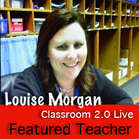
I was the Featured Teacher on today's Classroom 2.0 Live presentation today! If you have never participated in one of these Saturday presentations, it is well worth the the time.  I have learned so much about web 2.0 tools, best practices, classroom management, and more from these live webinars.

Today I talked about making the most of what you have. Instead of lamenting or complaining about what you DON'T have in your classroom, use what you DO have to its fullest potential!


In my presentation, I share how I made the decision to do more with technology in my classroom, goal setting, and examples of projects and tools that I have used to transform my classroom in to a global classroom.


LiveBinder Link: https://www.livebinders.com/play/play?id=937692
(Note: Click on tab for "Louise Morgan-Featured Teacher" in the LiveBinder)


Saturday, July 6, 2013

My Summer MUST Reads!


My goal for this summer is to read at least 2-3 books for fun/professional development. These are at the top of my list:

The Book Whisper 
by Donalyn Miller

Donalyn Miller says she has yet to meet a child she couldn't turn into a reader. No matter how far behind Miller's students might be when they reach her 6th grade classroom, they end up reading an average of 40 to 50 books a year. Miller's unconventional approach dispenses with drills and worksheets that make reading a chore. Instead, she helps students navigate the world of literature and gives them time to read books they pick out themselves. Her love of books and teaching is both infectious and inspiring. The book includes a dynamite list of recommended "kid lit" that helps parents and teachers find the books that students really like to read. Goodreads.com

The Passion-Driven Classroom 
by Angela Maiers and Amy Sandvold
Discover ways to cultivate a thriving and passionate community of learners – in your classroom! In this book, educators and consultants Angela Maiers and Amy Sandvold show you how to spark and sustain your students’ energy, excitement, and love of learning. Learn how to move away from prescription-driven learning toward passion-driven learning, and begin to make a real difference in the lives of your students. These strategies will help teachers in Grades K-12 put the "heart" back into teaching and learning – and make a lasting impact as educators.  Goodreads.com

Untangling the Web
By Adam Bellow and Steve Dembo
After attending #ISTE13 and hearing both Adam Bellow and Steve Dembo speak, I am excited about reading this book! Discover 20 free online learning tools and how to leverage technology to transform your classroom. Includes eBook component with hyperlinks, additional examples, and embedded videos. Goodreads.com

Teach Like a Pirate
by Dave Burgess

Based on Dave Burgess's popular "Outrageous Teaching" and "Teach Like a PIRATE" seminars, this book offers inspiration, practical techniques, and innovative ideas that will help you to increase student engagement, boost your creativity, and transform your life as an educator. You'll learn how to: Tap into and dramatically increase your passion as a teacher Develop outrageously engaging lessons that draw students in like a magnet Establish rapport and a sense of camaraderie in your classroom Transform your class into a life-changing experience for your students This groundbreaking inspirational manifesto contains over 30 hooks specially designed to captivate your class and 170 brainstorming questions that will skyrocket your creativity. Once you learn the Teach Like a PIRATE system, you'll never look at your role as an educator the same again. Goodreads.com

Drive: The Surprising Truth About What Motivates Us
by Daniel Pink


Drawing on four decades of scientific research on human motivation, Pink exposes the mismatch between what science knows and what business does—and how that affects every aspect of our lives. He demonstrates that while the old-fashioned carrot-and-stick approach worked successfully in the 20th century, it's precisely the wrong way to motivate people for today's challenges. In Drive, he reveals the three elements of true motivation:

*Autonomy—the desire to direct our own lives
*Mastery—the urge to get better and better at something that matters
*Purpose—the yearning to do what we do in the service of something larger than ourselves

Goodreads.com

I'm Participating in the 20% Time Academy (MOOC)!

photo source: 20% Time Academy
What is 20% Time?

Also referred to a Genius Hour or Passion Hour- Back in 2006, one of Google’s Technical Solutions Engineers wrote about how the company was “enabling engineers to spend one day a week working on projects that aren’t necessarily in our job descriptions. You can use the time to develop something new, or if you see something that’s broken, you can use the time to fix it.”
Many educators, since beginning to use Google Apps and other Google products, have adopted this concept into their classrooms. (Lisa Thumann - Thumann Resources)
What's a MOOC?

A MOOC is a Massively Open Online Course - anyone can participate and it's free

What is the 20% Time Academy MOOC about?

This course offers two outcomes: Teachers will learn about the research behind Google's 20% policy and how it can be applied in K-12 education. Learners will also participate in their own 20% project throughout the course and present as a final product.

Where can I learn more about 20% Time?

Check out this GoogleDoc

How do I attend class?

Live classes will be held via Google Hangout Monday July 8 and Monday July 15 - both at 8:00 pm EST

Are there assignments?

Yes, in fact this blog post is the first assignment - invite people to participate.  The other assignment for the first week is to browse Joy Kirr's Live Binder and learn more about 20% Time.

Where do I sign up?

Sign up at Schoology - use this access code: ZXQ2B-8CWMV