Showing posts with label science. Show all posts

Wednesday, October 23, 2013

Texas Science-Force and Motion


We just finished up a great unit on force and motion! I have done the spin, roll, and slide activities for the past few years, but this year I added a few more resources. 

In the science lab I set up 5 stations:

1. Spin: Students use Doodle Top Markers to spin and track the path of the spinning motion. I just use one large piece of butcher paper so that the spinners are free to roam as far and wide as they want.

2. Roll: Students roll marbles dipped in tempera paint on paper. They are given one marble at a time, one color at a time. When the marble gets dry, we switch to a new marble in a different color. I usually use 3. It works well using lids from copy paper boxes and 12 x 18 manilla paper. Be sure and have them put their name on their paper first. Students notice that it takes more force to move the marble when it rolls on to thicker parts of the paint. 

3. Slide: Students slide chalk on its side across colored construction paper to create a design. We also discuss the friction caused by the chalk and the paper. 

4. Ramps: Students use different sizes of card board, blocks, and tissue boxes to set up ramps. Then, they use objects like toy cars, wooden blocks, pencils, markers, rulers, and balls to explore speed, friction, and gravity.  I clipped felt on to one piece of cardboard and some silky fabric to another so the students could experiment with friction. 

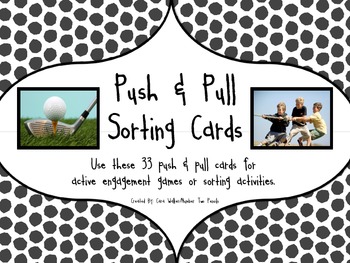
5. Push/Pull Sorting Activity: This challenging partner activity generated discussion and critical thinking. Students sorted pictures in to push and pull categories. Some were tricky. A few pairs decided to make a third category that included both push and pull. I found this FREE activity from Number Two Pencils on Teachers Pay Teachers. 

Spin, Roll, Slide flip book: This handy FREE download from In That Room on Teachers Pay Teachers made it easy for my students to complete their performance indicator. They folded, cut, wrote and drew descriptions of each motion on the inside flap.  

Additional Resources:  I signed up for the 60 day trial of Discovery Education Science Techbook and was delighted to find videos and interactive activities to supplement this unit. They have a Texas version that is in alignment with the Texas Essential Knowledge and Skills (TEKS) and the lessons are set up in the 5E format with easy to follow links. Some of the activities are also great for interactive white boards. We will use some of the resources from the Techbook for our next unit on magnetism.


Check out our learning!


Friday, March 29, 2013

VersaTiles Review and Giveaway

CONGRATULATIONS ALLISON! YOU WON!
Giveaway is now closed.
*Winner selected by random drawing at rafflecopter.com


 ETA hand2mind VersaTiles Science Starter Kit


I was first introduced to VersaTiles several years ago when one of our math teachers used them for after school math tutoring. I always thought that they were used only for math, but I recently discovered that they also have resources for science, readiness, and reading/language arts!

VersaTiles takes worksheets to he next level by requiring students to place number tiles on a corresponding letter that matches their answer. When all of the tiles have been placed, the students closes the answer case, flips it, and opens it back up. If the pattern matches the one at the bottom of the worksheet, the students has successfully answered all of the questions correctly. If the pattern does not match, the students can easily find their mistakes and make corrections.

I chose the Science Starter Kit because I have a hard time fitting in extra science activities. All of the workbooks have activities that fit perfectly with our scope and sequence.  My students have done activities relating to weather, the moon, and plants.  They are great for independent work or small groups.
The Science Starter Kit include a Teacher Resource Guide, 2 Science Process Skills,  Earth Science, Physical Science , and Life Science books. It also includes one answer case.

Students can work independently once they learn how to use VersaTiles. 

VersaTiles are engaging and challenging.
Students can self-check their work and make corrections. 
And now for the giveaway...
Win a VersaTiles Science Starter Kit!
Giveaway ends Sunday April 7th


a Rafflecopter giveaway

Friday, November 16, 2012

Magnet Stations!


Today we spent some time in the science lab exploring magnets by making predictions, testing, and playing with magnets! We used ring, horseshoe, and several bar magnets of different strengths.

I love this science unit because magnets are so fun and engaging. The students were especially fascinated by the compasses and how they changed direction depending on where they put the magnet.  

I haven't used our science books for the past few years since our district adopted C-Scope. The exemplary lessons and resources are such and improvement over our 10 year old textbooks! There is nothing better than hands-on learning!

Station 1: Predict how many paper clips a magnet will pick up. Test the actual amount of paper clips a magnet will pick up.

Station 2:  Predict which items will or will not attract a magnet. Test which items will or will not attract a magnet.

Station 3:  Experience "Attract" and "Repel" by placing same and opposite poles together on different types of magnets. It was fun to watch the ring magnets dance!

Station 4:  Guide a paper clip through a maze using a magnet under the table. Only the strongest magnets worked for this one.

Station 5:  Explore magnets using manipulatives:  Soda bottle filled with cut-up pipe cleaners, a sealed plastic container filled with sand and iron filings, and compasses.


Saturday, October 6, 2012

The Life Cycle of a Snowman 2012


Last year I created a snowman for my classroom and it was a huge success! This year I made 2 snowmen for our entire 2nd grade. All of the students enjoyed watching their snowman change throughout the day. I put the full instructions and the recording page on a Google Document. 
For full instructions and the recording sheet click HERE.
First, I filled balloons with water and froze them.
Lay a plate on top to create a flat surface
Next, after they were frozen, I stacked them. The biggest on the bottom, medium in the middle, and the smallest on top. I used some salt to help the ice stick together. Finally, I added some cut out felt pieces for the eyes, nose, mouth and buttons!
Using salt helps melt the ice a little and create a rough surface for adhesion.

The 3 States of Matter

In the morning, the students named the snowman and predicted what would happen to it by the end of the day. Throughout the day we watched as the snowman changed from solid to liquid as the ice melted.
Our snowman's head fell off while we were at lunch . We also measured the water throughout the day and saw how the  water rose as the snowman melted.
At the end of the day, I put the remains of our snowman in a electric skillet and turned it into a gas!
Using an electric skillet allowed the snowman to melt more quickly. Once the water in the pan came to a boil we were able to see the gas as evaporation occurred!
The students recorded what they saw and drew pictures in the morning, after lunch, and at the end of the day. It was a fun way to learn about the 3 states of matter. There were  many opportunities to talk about how the atoms were staying still or moving in each state. This song by They Might Be Giants is an excellent visual for this concept. We also added hand and body motions. 
We ended our day by discussing how we could use this information in every day situations and we created a question.

**Check out this awesome sequencing activity page 
created by Lauren Lynes!